

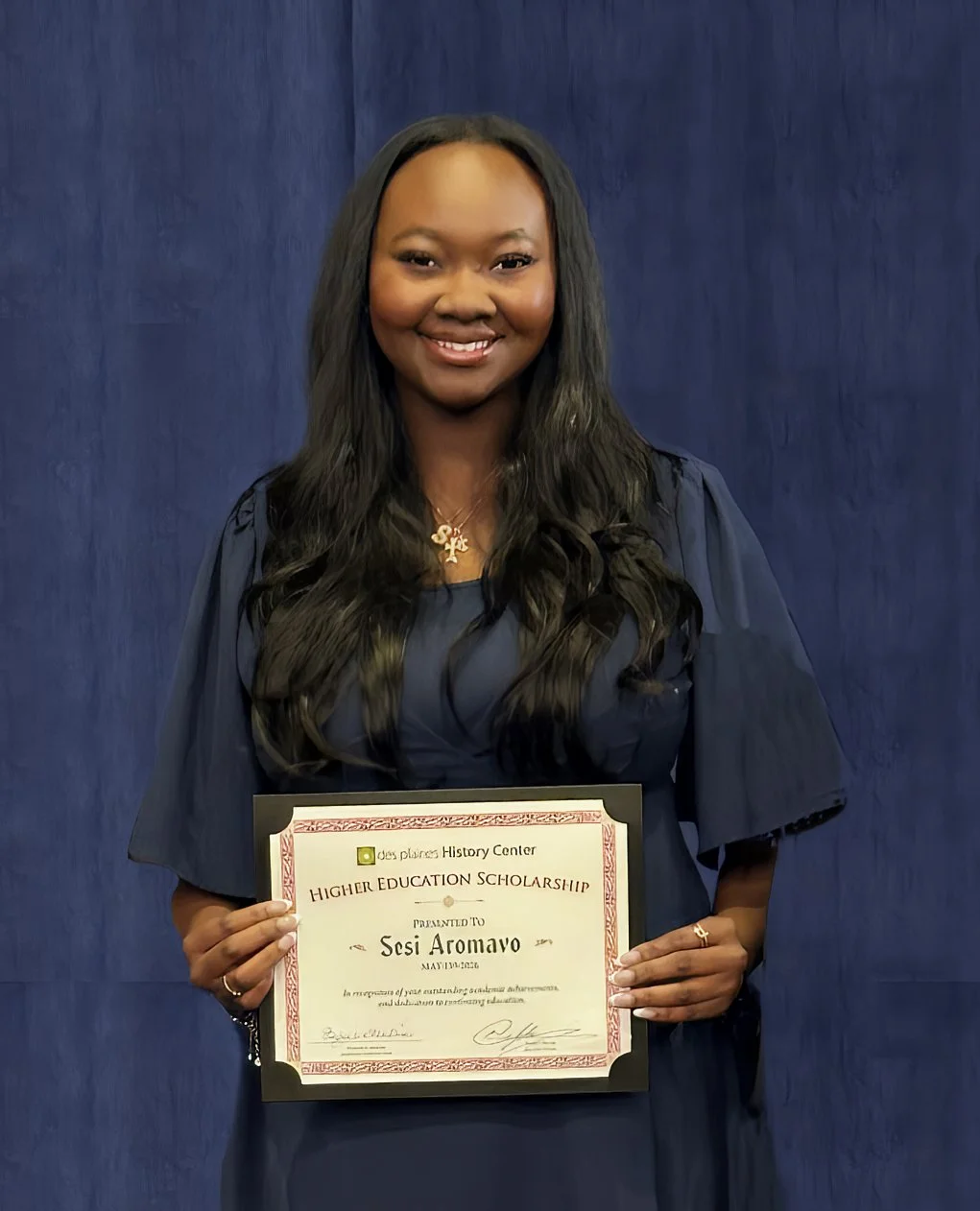
Ms. Aromavo’s winning essay stood out for its thoughtful and personal examination of what it means to be an engaged citizen today. Drawing from both historical and contemporary examples, she connected the ideals expressed in the Constitution and Declaration of Independence to modern-day issues involving immigration, civic activism, and equal protection under the law. Through reflections on her own leadership, volunteer service, advocacy, and family responsibilities, she demonstrated how young people can actively participate at every level to promote democracy and make meaningful contributions to our country.
2026 Higher Education
Scholarship Essay
By Sesi Aromavo
As the United States approaches its 250th anniversary, the ideals of liberty, equality, and justice outlined in the Declaration of Independence and the Constitution remain central to American identity, yet they are not fully realized. As a first-generation, low-income African American student, I see both the progress that has been made and the inequities that unfortunately persist. For my generation, being an engaged citizen means actively working to ensure these founding ideals become a true reality for all.
The US Constitution provides a clear foundation for civic responsibility. The Preamble calls citizens to “establish Justice” and “promote the general Welfare,” while the First Amendment protects freedoms of speech, assembly, and petition—rights that empower individuals to advocate for change. The Fourteenth Amendment’s Equal Protection Clause guarantees equality under the law, yet history shows this promise has required constant defense. In Brown v. Board of Education (1954), the Supreme Court used this amendment to overturn school segregation, proving that citizens and institutions must work together to expand rights over time.
However, modern challenges, recently of which particularly surround immigration, show how these ideals are still being tested. The increased role of Immigration and Customs Enforcement (ICE) has sparked national debate about due process and civil liberties. Across the country, and within my own community, students have organized walkouts to protest immigration enforcement practices and bring attention to their impact on families and communities. It's less than halfway through 2026, and we’ve already had thousands of students participate in nationwide “Free America Walkouts,” and “No Kings Protests,” demonstrating growing youth activism around immigration policy and the vulnerable state of our democracy. At my own school, students recently participated in an ICE walkout, using their voices to stand up for immigrant communities and exercise their First Amendment rights. Being part of a school environment where students are willing to speak out reinforced my belief that civic engagement is not something reserved for adults, it is a responsibility we can and must take on, especially now when younger voices are too often shut out and left unheard.
At the local level, meaningful citizenship begins with direct involvement. Through my role as Student Council President, I work to represent student voices and foster inclusion within my school community, but these ideals branch into families and homes, which further impacts my community. My volunteer work (mentoring students at the Niles Public Library, supporting children at my church, and assisting students with special needs) reflects the idea expressed by Dr. Martin Luther King Jr. in his “Letter from Birmingham Jail” that individuals have a moral responsibility to act against injustice.
At the state and federal levels, my generation must stay informed and participate in democratic processes such as voting and advocacy. The system of checks and balances as described in Federalist No. 51, written by James Madison, emphasizes that the government depends on active and engaged citizens to function properly. My experience as a Lead Attorney in Mock Trial has strengthened my understanding of the legal system and inspired my goal of pursuing law to promote fairness and accountability within these institutions.
Finally, citizenship requires personal responsibility and resilience. Supporting my family by working, cooking, and caring for my younger brother has taught me accountability and discipline. These values shape how I approach civic life, reinforcing my commitment to contribute meaningfully to my community.
Ultimately, being an engaged citizen in a modern democracy means more than understanding rights, it also means using them. By participating in our communities, advocating for justice, and holding institutions and the government accountable, my generation can help bring the Constitution’s promises of liberty and equality closer to reality.
Sources
U.S. Constitution (Preamble, First Amendment, Fourteenth Amendment)
Brown v. Board of Education, 347 U.S. 483 (1954)
Martin Luther King Jr., “Letter from Birmingham Jail” (1963) James Madison, Federalist No. 51 (1788)
National Archives: Founding Documents of the United States